Archive for December, 2010

Part 12: Finding Pure Essential Oils

Thursday, December 30th, 2010

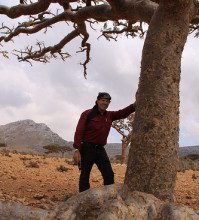
Gary investigating the socotrana species of frankincense on the island of Socotra

I have been in Oman 15 times over 15 years. I have built two distilleries in Salalah and have walked the mountains from the eastern Dhofar Mountains east of Hasik to the border of Yemen, harvesting frankincense resin. While exploring and conducting research in Oman with my film crew, Don Muirhead and John Whetten, we found the legendary Wadi Andhur Treasury House that was said by the Minister of Antiquities and the Minister of History and Museums to no longer exist. We were excited to make this great discovery and be the first people to film it.

I have walked the mountains in the Hadhramaut in the interior of Yemen, harvested frankincense, brought the resin home, and distilled it so that I would know without question what species it is. Yemeni frankincense is similar to the Boswellia sacra but matches closer to the Boswellia carteri. I combed the mountains on Socotra Island from the Homhil Plateau to the western shores of Qalansiya.

I do not make statements without facts, without going there to see for myself. But there is a price to pay to get the truth and an even higher price to pay to get pure essential oils. Traveling to these areas and backpacking up and down and around the mountains in difficult terrain challenges the hearty, which is why there is so much misinformation and untruths written and published in books.

Very few individuals are willing to pay the price, since it is easier to copy other people’s information, claim someone else’s stories as their own, or just make it up when they simply don’t know what they are taking about.

To be continued . . .

Technorati Tags: , , , , , , , , , , , , ,

Part 11: Finding Pure Essential Oils

Thursday, December 23rd, 2010

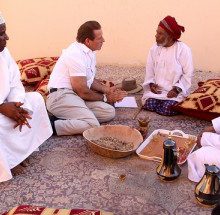
Gary learns about frankincense from Musallam, one of the last remaining caravaners in Salalah, Oman.

Today throughout the world, natural and nature identical do not mean the same thing. Nature identical means that single or compound chemicals that are found in nature have been duplicated synthetically.

Essential oils can be made synthetically in their entirety, or individual compounds can be made synthetically, added to the essential oil, and then labeled nature identical. However, most people don’t understand that, so when they read nature identical, they think they are getting the same substance or material that God created in nature. Unfortunately, they don’t realize that in reality, they are getting a synthetic product manufactured in a laboratory.

It’s easy for me to tell that some competitors have never traveled outside the United States or conducted any research anywhere. It is obvious to see that they are more concerned with marketing hype than they are with the truth. I am proud of the purity and efficacy of Young Living’s essential oils and have traveled the world extensively to go directly to the source to monitor production and guarantee the quality, rather than accepting the word of a broker.

To be continued . . .

Technorati Tags: , , , , , , , ,

Part 10: Finding Pure Essential Oils

Thursday, December 16th, 2010

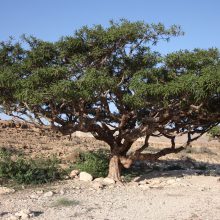
Omani frankincense tree

Many people have tried to enter the essential oil market and have no idea about what it takes to produce a pure therapeutic grade essential oil, what to look for in the chemistry profile, or even how to read a GC-MS analytical evaluation. They rely on a broker to tell them whether the essential oils they are buying are pure. You might as well buy from a used-car salesman.

Some companies proudly state that their Boswellia frereana is sourced in Oman. Unfortunately, that is just not true. This species of frankincense grows only in Somalia. In addition, there have been some exaggerated claims of how much boswellic acid or incensole acetate can be found in frereana. The truth is that neither of those compounds is found in frereana at all.

I prefer to back up my statements with peer-reviewed research from the Web site of the National Library of Medicine: www.pubmed.gov. A paper on frankincense research is available to you in a downloadable PDF if you click here. This paper will give you real, documented facts on three frankincense varieties: carteri, sacra, and frereana.

I can tell you that Young Living’s Boswellia carteri frankincense comes from East Africa. The Boswellia sacra that we sell as Sacred Frankincense is grown in Oman and distilled in my own distillery in Salalah, Oman. I studied the therapeutic properties of these two varieties of frankincense that are very rich in boswellic acid and incensole acetate and concluded that they offer the most benefits to consumers.

To be continued . . .

Technorati Tags: , , , , , , , , , , , , , , ,

Part 9: Finding Pure Essential Oils

Thursday, December 9th, 2010

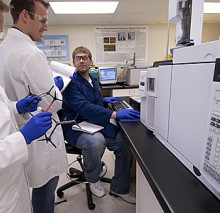
Young Living's GC-MS in Spanish Fork, UT lab

Our research and quality control laboratories in Utah have three gas chromatograph (GC) instruments.  Two of these GC instruments possess dual-FID detectors, auto-injectors, and auto-samplers. The FID (flame ionization detector) counts carbons in the aromatic molecule so that its structure can be compared to a reference sample. Auto-injectors automatically inject the essential oil, and the auto-sampler allows you to program a series of injections for precise quantity and timing if you run multiple samples in sequence.

We use these instruments daily to routinely evaluate every new batch of essential oil that enters Young Living to verify that it meets strict Young Living Therapeutic Grade™ standards, a term that I coined in 1991. The third GC instrument has an FID and mass spectrometer (MS). This third GC-MS is reserved for research to identify individual components of new essential oils before they are introduced to distributors.

In May 2010 I built a new laboratory and installed our first GC in Ecuador, and on September 8, 2010, our new mass spectroscopy detector (MSD) arrived. It ionizes molecules and then scans them, providing a “molecular fingerprint.”

We are also adding a polarimeter, which measures optical rotation. Optical rotation allows us another means to check for purity and possible adulteration.

Our essential oil chemical reference library has over 280,000 compound references that have taken us 12 years to compile. Today, with the instruments Young Living owns in our two laboratories, we posses the most advanced and complete laboratories in North and South America for the analysis of plant compounds and their identity.

Our instruments are the only ones in the world that are matched and calibrated to the instruments used in the Central Service Laboratory in France by Dr. Hervé Casabianca, who was on the directing committee that wrote the AFNOR Standards, which are accepted worldwide as the average essential oil standards. With Dr. Casabianca’s help, Young Living is raising the bar for the standards of essential oils.

To be continued . . .

Technorati Tags: , , , , , , , , , , , , , ,

Part 8: Finding Pure Essential Oils

Wednesday, December 1st, 2010


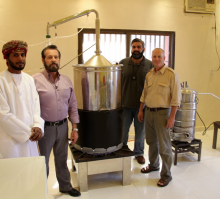
Mr. Abdullah Hamden; Gary Young; Mahmoud Suhail, M.D.; and Cole Woolley at the YL distillery

In November of 2006, I found myself in Ecuador expanding Young Living’s farmland.  I purchased 1,125 acres of raw, virgin land and filed a lease/claim on an additional 1,200 acres in 2007.

In March of 2010, our farm operations expanded into Salalah, Oman, the heart of the frankincense land in Arabia.  Currently, we are leasing a 3,400-square-meter farm, which produces bananas, pomegranates, lemons, coconuts, and papayas.

Young Living has agreements with local harvesters to secure our supply of Omani resin, which is distilled in our newest Young Living distillery located on our farm in Salalah. The distillery has two distillers and a two-room building with an office. From there the Boswellia sacra (Sacred Frankincense) oil is shipped to the Young Living warehouse in Utah from where it is distributed worldwide.

Here is a summary of our Young Living farms and what we grow at each:

Farm 1: St. Maries, Idaho (lavender, melissa, Idaho tansy, and various conifers)

Farm 2: Provence, France (lavender; leased farm in central France, which I no longer lease)

Farm 3: Mona, Utah (lavender, clary sage, hyssop, goldenrod, Roman chamomile, and other small crops)

Farm 4: Simiane, France (lavender; located in the southern region of France)

Farm 5: Naples, Idaho, just south of the Canadian border (balsam fir trees)

Farm 6: Guayaquil, Ecuador (ruta, palo santo, dorado azul, eucalyptus blue, zaragosa, rosa  morta, oregano, ylang ylang, ishpingo, ocotea, and other exotic oils; located in the rural area of Chongon on the outskirts of Guayaquil)

Farm 7: Salalah, Oman (bananas, pomegrantes, lemons, coconuts,  and papayas)

To be continued . . .

Technorati Tags: , , , , , , , , , , ,